




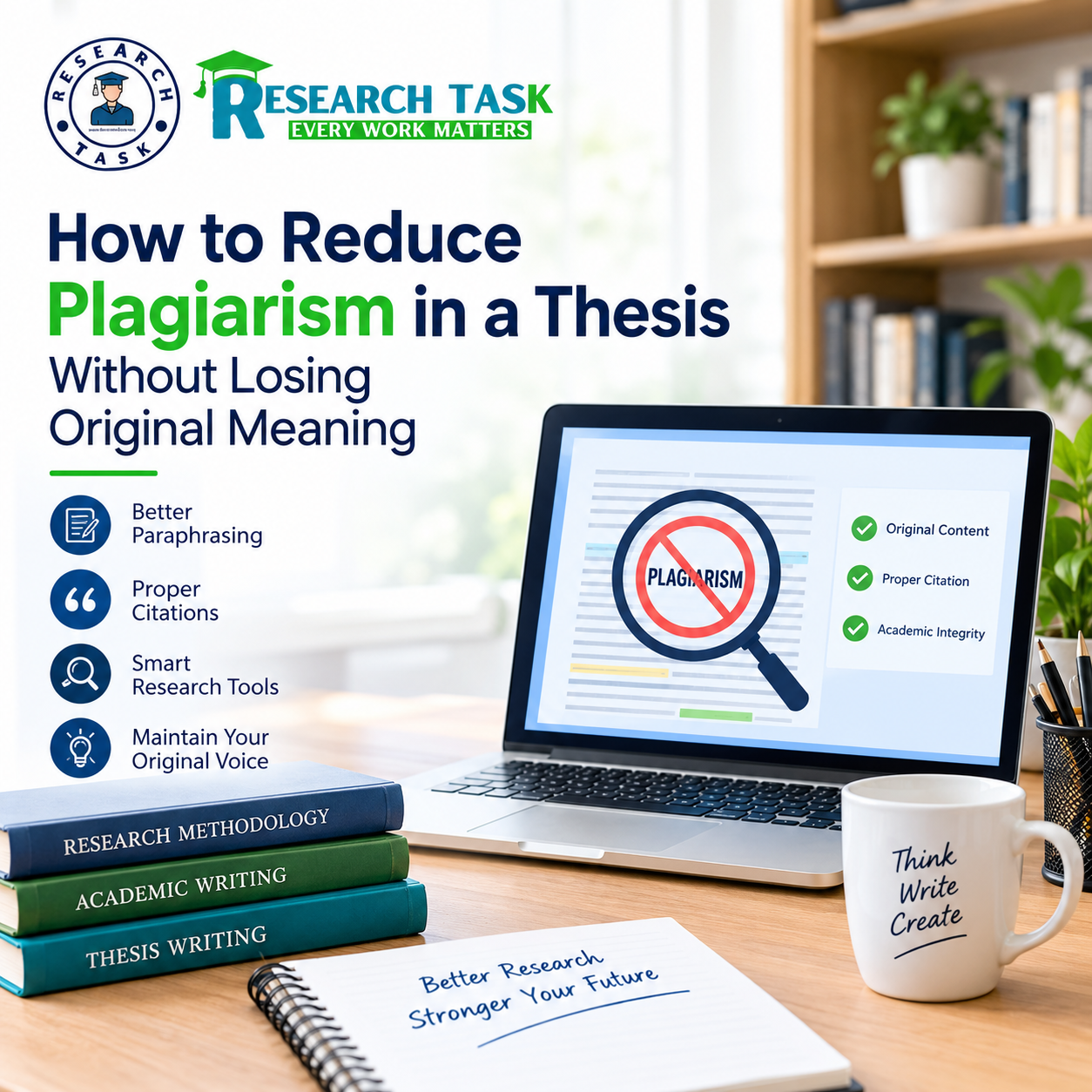
Writing a thesis requires extensive research, careful analysis, and the ability to present ideas clearly. During this process, students often refer to books, research papers, journals, websites, and previously published studies. Although using existing research is an essential part of academic writing, presenting another person’s words or ideas without proper acknowledgment can lead to plagiarism.
Many research scholars face a common challenge: how to reduce plagiarism in a thesis without changing the original meaning of the content. Simply replacing words with synonyms is not enough. Effective plagiarism prevention requires understanding the source material, expressing ideas in your own words, providing accurate citations, and maintaining the accuracy of research findings.
In this guide, we will explore practical ways to reduce plagiarism while preserving the quality, originality, and academic value of your thesis.
What Is Plagiarism in Academic Writing?
Plagiarism occurs when someone uses another person’s words, ideas, Research Findings, or intellectual contributions without appropriate acknowledgment. It can happen intentionally or unintentionally, particularly when researchers fail to record their sources or misunderstand citation requirements.
Common forms of plagiarism include:
- Direct plagiarism: Copying sentences or paragraphs from a source without quotation marks or proper acknowledgment.
- Paraphrasing plagiarism: Rewriting someone else’s work by changing a few words while retaining the original structure without appropriate citation.
- Self-plagiarism: Reusing substantial portions of previously submitted or published work without appropriate disclosure or permission where required.
- Mosaic plagiarism: Combining phrases or passages from multiple sources with minimal changes and inadequate acknowledgment.
- Citation-related plagiarism: Using information or ideas from a source without providing the necessary citation.
Understanding these types of plagiarism helps researchers identify potential problems before submitting their thesis.
Why Is It Important to Reduce Plagiarism in a Thesis?
Academic integrity is an essential requirement for postgraduate and doctoral research. A thesis should demonstrate the researcher’s understanding, critical thinking, analytical skills, and contribution to the subject.
Reducing plagiarism is important for several reasons.
1. Maintains academic integrity
Proper attribution acknowledges the work of original researchers and demonstrates responsible academic practice.
2. Improves writing quality
Paraphrasing and synthesizing information encourage students to understand research concepts instead of relying heavily on copied material.
3. Protects academic credibility
Unacknowledged copying can lead to rejection, disciplinary action, or reputational damage, depending on the institution’s policies and the seriousness of the issue.
4. Strengthens research originality
A well-written thesis combines existing knowledge with the researcher’s own interpretation, analysis, and conclusions.
5. Supports university submission requirements
Many universities use similarity-checking software as part of their thesis evaluation process. Understanding the results allows researchers to review citations, quotations, and potentially problematic passages before submission.
10 Effective Ways to Reduce Plagiarism Without Losing Original Meaning
1. Understand the Source Before Rewriting It
One of the most effective ways to reduce plagiarism is to understand the source material before attempting to rewrite it.
Read the original passage carefully and identify its main argument, supporting evidence, and intended meaning. Once you understand the concept, explain it in your own words without looking at the original sentence structure.
For example, instead of immediately replacing individual words, ask yourself what the author is actually communicating and how the idea relates to your research.
This method helps you produce meaningful academic writing rather than superficial paraphrasing.
2. Use Proper Paraphrasing Techniques
Paraphrasing means expressing an idea from an existing source using your own wording and sentence structure while preserving the author’s intended meaning.
To paraphrase effectively:
- Read the source paragraph more than once.
- Identify its central idea and supporting details.
- Set the original passage aside.
- Explain the concept in your own writing style.
- Compare your version with the source to check accuracy.
- Add the appropriate citation.
Remember that paraphrasing does not remove the need for attribution. Even when you completely rewrite a sentence, you must cite the original source if the idea comes from another researcher.
3. Avoid Replacing Words With Synonyms Only
Changing a few words in a copied paragraph does not necessarily make it original. The sentence structure, argument, and sequence of ideas may remain too close to the source.
For instance, replacing words such as important, significant, or essential without restructuring the sentence is unlikely to produce effective paraphrasing.
Instead, focus on understanding the concept and explaining it independently. You can reorganize the information, combine related findings from multiple sources, and connect the evidence to your research question, provided that you accurately represent the sources and cite them appropriately.
The goal is not simply to make the wording different; it is to demonstrate genuine understanding.
4. Cite All Sources Correctly
Proper referencing is one of the most important steps in preventing plagiarism.
Whenever you use another researcher’s idea, theory, data, findings, or distinctive argument, provide an appropriate citation. Follow the referencing style required by your university or department.
Common academic referencing styles include:
- APA
- MLA
- Harvard
- Chicago
- IEEE
Each style follows different rules for in-text citations, footnotes, and reference lists.
Maintain a record of the author, publication year, title, journal or publisher, page numbers where relevant, and DOI or URL when applicable. Reference management tools can help organize these details and reduce citation errors.
5. Use Direct Quotations When Necessary
Some statements are best presented in their original wording, particularly when discussing a formal definition, a legal provision, or a passage whose precise language is important to the analysis.
In these cases, use quotation marks or the appropriate block-quotation format and provide a citation with the required location details, according to your referencing style.
However, avoid filling your thesis with lengthy quotations. Use them selectively and explain their significance in your own analysis.
A strong thesis demonstrates your understanding of the literature rather than relying entirely on the words of other authors.
6. Add Your Own Analysis and Interpretation
A thesis should not be a collection of summaries from different research papers. It should demonstrate how existing knowledge relates to your research objectives.
After presenting a finding from an earlier study, explain what it means, how it compares with other findings, and why it matters to your research.
For example, you might compare two studies that reach different conclusions, examine possible reasons for the differences, or identify an unanswered question that supports your research objectives.
This approach strengthens the originality of your work because you are critically engaging with the literature instead of simply reproducing it.
Your interpretation must remain consistent with the available evidence, and citations are still required for the underlying research findings.
7. Keep Accurate Research Notes
Poor note-taking can lead to accidental plagiarism. Researchers may forget which sentences were copied directly, which ideas were paraphrased, and where particular findings originated.
To avoid this problem, maintain a research notebook or digital document containing:
- Source details and publication information.
- Direct quotations clearly marked with quotation marks.
- Your own summaries and interpretations.
- Page numbers or section references.
- Citations associated with each key finding.
Keep your notes organized by thesis chapter or research theme. This makes it easier to verify information and add accurate citations while drafting.
8. Use Plagiarism-Checking Software Responsibly
Similarity-checking tools can help identify passages that resemble existing published or submitted material. These tools are useful for reviewing a thesis before submission, but their reports require careful interpretation.
A similarity percentage does not automatically establish plagiarism. Properly cited quotations, reference lists, standard terminology, and commonly used academic phrases may contribute to a similarity score.
When reviewing a report:
- Examine each highlighted passage individually.
- Check whether the passage is correctly quoted or paraphrased.
- Verify that the original source has been cited.
- Rewrite unnecessarily close paraphrases.
- Correct missing or incomplete references.
- Confirm that technical terminology and research findings remain accurate.
Do not focus exclusively on achieving the lowest possible similarity percentage. The objective is to ensure that the thesis is original, properly attributed, and compliant with your institution’s academic integrity requirements.
9. Be Careful When Using AI Writing Tools
AI-powered writing tools can assist with grammar correction, clarity, outlining, and language improvement. However, using them without proper review can introduce inaccurate information, fabricated references, or wording that does not reflect your intended argument.
If you use AI tools, follow your university’s policies regarding permitted use and disclosure.
You should:
- Verify factual statements against reliable sources.
- Check every reference before including it in your thesis.
- Review rewritten passages to ensure they retain the correct meaning.
- Cite the original research that supports the claims.
- Avoid submitting generated content that you cannot explain or defend.
- Never use AI tools to disguise copied work or bypass plagiarism checks.
AI should support your research and writing process, not replace critical thinking or responsible source attribution.
10. Review Your Thesis Before Submission
A final review helps identify citation mistakes, unclear paraphrasing, repeated passages, and inconsistencies between the text and reference list.
Before submitting your thesis, check each chapter carefully.
Ensure that every borrowed idea has appropriate attribution, direct quotations follow the required format, and the reference list includes the sources cited in the text.
Also review your research objectives, methodology, results, and conclusions to confirm that editing has not changed their intended meaning.
If your institution provides specific similarity thresholds or submission guidelines, follow those requirements rather than relying on a universal percentage.
How to Reduce Plagiarism While Preserving the Original Meaning
Maintaining the original meaning is particularly important when paraphrasing research findings, technical explanations, statistical interpretations, and theoretical concepts.
Use the following checklist when revising a passage:
| Review area | What to check |
|---|---|
| Main idea | Does the revised passage communicate the same central concept? |
| Accuracy | Are the original findings and supporting evidence represented correctly? |
| Terminology | Have essential technical terms been retained where necessary? |
| Sentence structure | Is the explanation independently written rather than copied with minor changes? |
| Attribution | Have the original author and source been acknowledged? |
| Context | Does the revised passage preserve relevant qualifications and limitations? |
| Integration | Have you explained how the information relates to your research? |
Avoid removing qualifying words such as may, potentially, or under certain conditions if they are important to the original claim. Changing a cautious finding into a definitive statement can distort the research, even if the revised sentence appears more polished.
Common Mistakes to Avoid When Reducing Plagiarism
Researchers sometimes make the following mistakes while trying to improve the originality of their thesis:
- Replacing individual words without restructuring the explanation.
- Removing citations after rewriting a paragraph.
- Changing technical terms that are essential to the subject.
- Using automated paraphrasing tools without checking accuracy.
- Deleting relevant information simply to lower a similarity score.
- Ignoring similarities with the researcher’s own previously published work.
- Assuming that every similarity match represents plagiarism.
- Relying on AI-generated references without verifying them.
Avoiding these mistakes helps preserve the academic quality of your thesis while supporting responsible research practices.
Final Thoughts
Reducing plagiarism in a thesis requires more than changing words or lowering a similarity score. It involves understanding existing research, paraphrasing carefully, citing sources correctly, developing your own analysis, and reviewing every chapter for accuracy.
The most effective approach is to treat existing literature as the foundation for your research rather than as content to reproduce. When you combine proper attribution with independent interpretation, you can create a thesis that maintains the original meaning of important research findings while demonstrating your own academic understanding.
If you need additional guidance, Research Task can help research scholars understand thesis structure, research methodology, academic writing, and citation practices. The right guidance can make the thesis-writing process more organized and help you prepare your work in accordance with your university’s requirements.
Frequently Asked Questions (FAQs)
1. How can I reduce plagiarism in my thesis without changing the meaning?
Understand the source, rewrite the concept in your own words, preserve important technical details, and cite the original author. Review the revised passage against the source to ensure that its meaning remains accurate.
2. Does paraphrasing remove plagiarism?
Paraphrasing alone does not remove plagiarism. If an idea comes from another source, you must acknowledge it even when the wording and sentence structure are completely different.
3. What is an acceptable similarity percentage for a thesis?
There is no single acceptable similarity percentage for every thesis. Requirements differ across universities, departments, disciplines, and publications. Always follow your institution’s guidelines and review individual matches rather than relying on the percentage alone.
4. Can plagiarism-checking software detect paraphrased content?
Some tools may identify textual similarities, while others have additional features for detecting certain forms of paraphrased content. However, no tool can guarantee the detection of every instance of plagiarism. Human review and proper citation remain essential.
5. Can AI tools help reduce plagiarism in academic writing?
AI tools can assist with grammar, clarity, and rewriting, but their output must be checked for accuracy and originality. They should not be used to conceal copied work or bypass academic integrity checks.
6. How can I avoid accidental plagiarism while writing my thesis?
Record source details as you research, clearly distinguish quotations from your own notes, cite borrowed ideas immediately, and review your references before submission. These habits help prevent accidental omissions and attribution errors.