




Writing a dissertation is a long academic process that involves research, data collection, analysis, interpretation, and extensive writing. Even when the research is strong, small language, formatting, and consistency issues can affect how professionally the final dissertation is presented.
This is where Dissertation Proofreading Services in Canada can be useful. Professional proofreading focuses on identifying errors and improving the readability and consistency of a dissertation before it is submitted to a university or reviewed by an academic committee.
But what exactly does dissertation proofreading include? Is it the same as editing? And how can a PhD student choose the right proofreading service?
This guide explains the major areas covered by professional dissertation proofreading and what students should look for before submitting their final work.
What Are Dissertation Proofreading Services in Canada?
Dissertation proofreading is the final quality-checking stage of academic writing. It involves carefully reviewing a completed dissertation to identify errors that may have been missed during the writing and editing process.
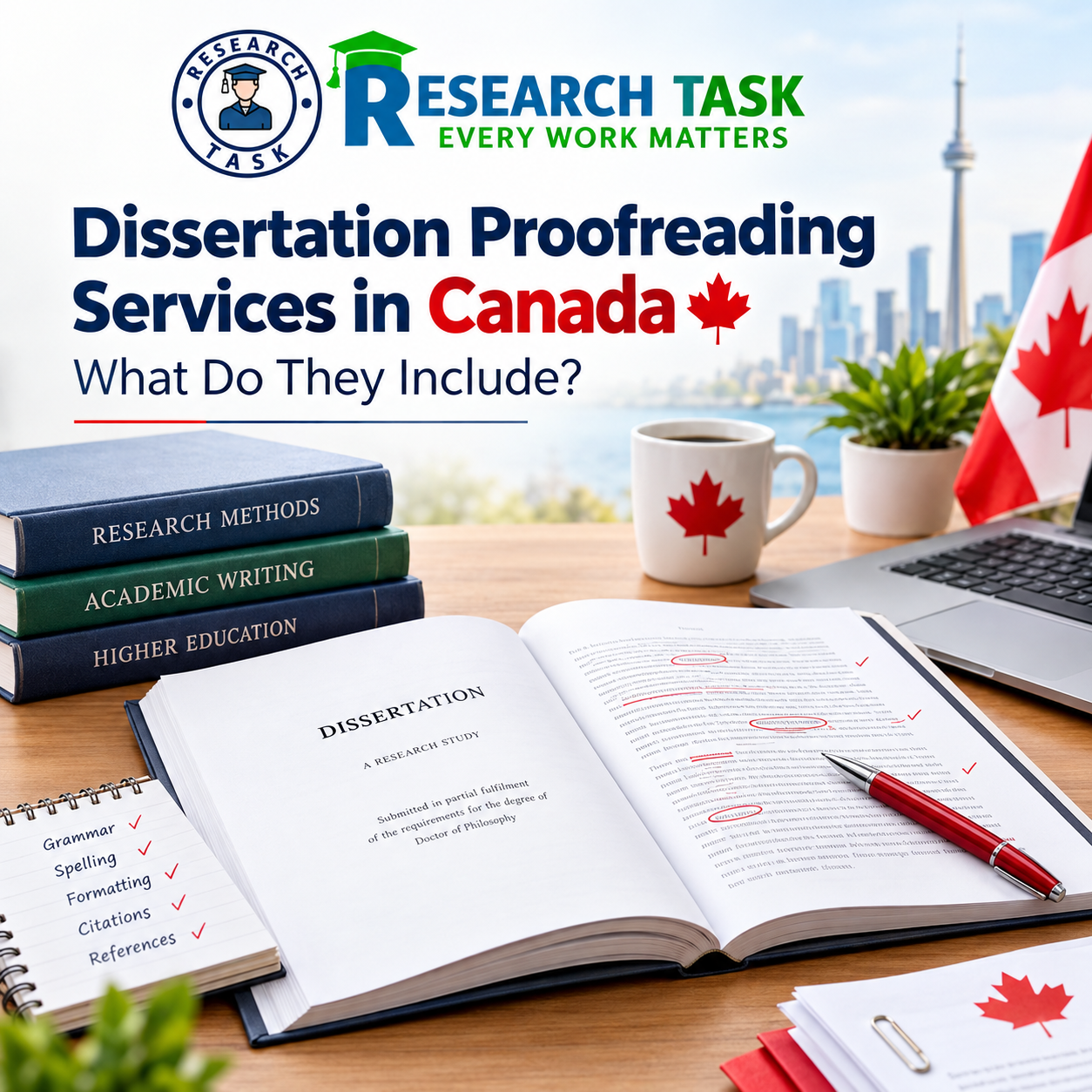
A professional proofreader may review:
- Grammar and sentence structure
- Spelling and punctuation
- Academic language and tone
- Formatting consistency
- Headings and subheadings
- Tables and figures
- In-text citations
- Reference-list consistency
- Abbreviations and terminology
- Page numbering
- Cross-references
- Typographical errors
The purpose is not to change the researcher’s findings or arguments. Instead, proofreading helps ensure that the dissertation communicates the research clearly and is presented in a polished and consistent manner.
What Do Dissertation Proofreading Services Include?
The exact scope varies between providers, but comprehensive dissertation proofreading services in Canada generally cover several important areas.
| Proofreading Area | What Is Checked |
| Grammar | Grammatical errors, verb usage and sentence construction |
| Spelling | Misspelled words and typing mistakes |
| Punctuation | Commas, full stops, quotation marks and other punctuation |
| Academic Style | Formality, clarity and consistency of academic language |
| Formatting | Headings, spacing, fonts and document consistency |
| Citations | Consistency between citations and the required referencing style |
| References | Formatting and consistency of the reference list |
| Tables & Figures | Numbering, captions, labels and cross-references |
| Terminology | Consistent use of technical terms and abbreviations |
| Final Review | Overall consistency and presentation |
1. Grammar and Sentence Structure
Grammar mistakes can make otherwise strong academic writing difficult to understand. Proofreading checks sentence construction, verb agreement, tense, articles, prepositions and other grammatical elements.
For example, a dissertation may contain sentences that are technically understandable but unnecessarily complicated. A proofreader can identify such issues and suggest clearer wording while maintaining the intended academic meaning.
2. Spelling and Typographical Errors
Long dissertations can contain hundreds of pages, making it easy for small typing mistakes to go unnoticed.
Professional proofreading can identify:
- Misspelled words
- Repeated words
- Missing words
- Incorrect word choices
- Typographical errors
- Inconsistent spelling
These details may seem minor, but correcting them can make the final dissertation appear considerably more professional.
3. Academic Language and Tone
A dissertation needs to maintain an appropriate academic tone throughout its chapters.
Proofreading can identify language that is:
- Too informal
- Unnecessarily repetitive
- Unclear
- Ambiguous
- Excessively wordy
- Inconsistent with academic writing conventions
The objective is to make the writing clearer without changing the researcher’s original ideas, findings, or conclusions.
4. Punctuation
Incorrect punctuation can change the meaning of a sentence or interrupt the flow of academic writing.
A proofreading review may check:
- Commas
- Colons
- Semicolons
- Full stops
- Apostrophes
- Quotation marks
- Hyphens
- Parentheses
Consistent punctuation is particularly important in long academic documents.
Dissertation Formatting and Consistency Checks
Proofreading is not limited to grammar. A dissertation also needs to follow the formatting requirements specified by the relevant university, department, faculty, or program.
Formatting requirements can differ, so students should always consult their institution’s current dissertation guidelines.
A proofreading review may identify inconsistencies involving:
- Font styles and sizes
- Line spacing
- Paragraph spacing
- Heading levels
- Margins
- Page numbers
- Chapter titles
- Table and figure captions
- Footnotes
- Appendices
- Section numbering
A well-formatted dissertation is easier for supervisors, examiners, and readers to navigate.
Citation and Reference Checking
Academic dissertations usually contain a substantial number of sources. Maintaining consistency across hundreds of citations and references can be difficult.
Depending on the agreed scope, proofreading may check whether the selected referencing style has been applied consistently.
Common styles include:
- APA
- MLA
- Chicago
- Harvard
- Vancouver
- IEEE
For example, the formatting of author names, publication dates, titles, journal information, page numbers, and URLs may need to follow a particular style.
A proofreading service should not be assumed to verify every source’s authenticity or whether a citation actually supports a particular academic claim unless that service is specifically included.
Tables, Figures, and Cross-References
Research-heavy dissertations often contain tables, charts, diagrams, graphs, and figures.
These elements can create additional opportunities for errors.
A proofreader may check:
- Figure and table numbering
- Captions
- References to figures in the text
- References to tables in the text
- Consistency of labels
- Placement and formatting
- Cross-references
For example, if the text refers to “Table 4.2” but the actual table is labelled “Table 4.3,” this inconsistency should be corrected before submission.
Terminology and Abbreviation Consistency
Researchers often use specialized terminology throughout their dissertations.
A term may accidentally be written in different forms in different chapters. Abbreviations can also be introduced incorrectly or used before being defined.
Proofreading can help identify:
- Inconsistent terminology
- Different spellings of technical terms
- Undefined abbreviations
- Inconsistent capitalization
- Incorrect use of acronyms
Maintaining terminology consistency is particularly important for technical, scientific, medical, business, and social science research.
Proofreading vs Dissertation Editing: What Is the Difference?
Proofreading and editing are related but different services.
Editing generally involves a deeper review of the writing. Depending on the level of editing, it may address organization, clarity, flow, paragraph structure, wording, and overall readability.
Proofreading is usually the final review after the content has already been written and edited. It focuses primarily on identifying remaining errors and inconsistencies.
| Dissertation Editing | Dissertation Proofreading |
| May involve substantial language improvements | Focuses on final errors |
| Can address structure and flow | Checks consistency and presentation |
| May improve paragraph organization | Identifies grammar and punctuation issues |
| Can involve rewriting unclear passages | Usually makes more limited changes |
| Often performed before final proofreading | Usually the final language review |
If a dissertation requires major restructuring, proofreading alone may not be sufficient. If the content is already finalized and the main concern is errors and consistency, proofreading may be more appropriate.
Why Do PhD Students Consider Professional Proofreading?
Completing a dissertation requires significant time and concentration. After working on the same document for months or years, researchers can become less likely to notice small errors in their own writing.
A fresh review can help identify issues that the author may have overlooked.
Professional proofreading may help with:
Improved Readability
Clear sentences make complex research easier to understand.
Greater Consistency
Consistent headings, terminology, references, tables, and formatting create a more organized document.
Fewer Language Errors
Grammar, spelling, punctuation, and typographical errors can be identified before final submission.
Better Presentation
A polished dissertation demonstrates attention to detail and makes the document easier to navigate.
Time Savings
Instead of repeatedly reviewing hundreds of pages themselves, researchers can use professional support for the final quality-checking stage.
Who Can Benefit From Dissertation Proofreading Services in Canada?
Dissertation proofreading can be useful for different types of researchers, including:
- PhD candidates
- Doctoral researchers
- Master’s students
- Academic researchers
- International students studying in Canada
- Researchers preparing manuscripts from dissertation work
- Students preparing final thesis or dissertation submissions
It can be particularly useful for researchers who are confident about their research but want an additional review of the written document before submission.
How to Choose Dissertation Proofreading Services in Canada
Choosing a proofreading provider requires more than searching for the cheapest option. Academic writing is specialized, and a dissertation requires a different level of attention from ordinary business or general proofreading.
Consider the following factors:
1. Academic Experience
Look for a provider familiar with dissertations, theses, research papers, and academic writing.
2. Subject Knowledge
If your research contains specialized terminology, working with someone familiar with your academic field can be beneficial.
3. Clear Service Scope
Ask exactly what the proofreading service includes. For example, does it cover grammar only, or does it also include formatting, references, tables, figures, and consistency checks?
4. Referencing Style
Confirm whether the service can work according to your required citation style, such as APA, MLA, Chicago, Harvard, or another style.
5. Confidentiality
A dissertation contains original research and potentially unpublished academic material. Review the provider’s confidentiality and data-handling policies before sharing your document.
6. Transparent Pricing
Understand whether pricing is based on word count, page count, document length, turnaround time, or the level of service required.
7. Revision Policy
Check whether the provider offers clarification or revisions if you have questions about the proofreading changes.
Dissertation Proofreading Checklist Before Submission
Before submitting your dissertation, use a final checklist to review the document.
| Checklist Item | Completed? |
| Grammar and spelling reviewed | ☐ |
| Punctuation checked | ☐ |
| Headings are consistent | ☐ |
| Chapter numbering is correct | ☐ |
| Page numbers are correct | ☐ |
| Tables are numbered correctly | ☐ |
| Figures are numbered correctly | ☐ |
| In-text citations are consistent | ☐ |
| Reference list has been reviewed | ☐ |
| Abbreviations are consistent | ☐ |
| Cross-references are accurate | ☐ |
| Appendices are correctly labelled | ☐ |
| Formatting follows university guidelines | ☐ |
| Final document has been reviewed | ☐ |
Frequently Asked Questions
1. What are dissertation proofreading services in Canada?
Dissertation proofreading services involve reviewing a completed thesis or dissertation for language errors, grammar, spelling, punctuation, formatting inconsistencies, citation issues, terminology inconsistencies, and other presentation-related problems. The exact services included depend on the provider and the package selected.
2. Is dissertation proofreading the same as dissertation editing?
No. Editing generally involves a deeper review of language, clarity, structure, flow, and organization, while proofreading is normally a final review focused on errors and consistency. Some providers offer both services as separate or combined packages.
3. Can proofreading change the meaning of my research?
Professional proofreading should preserve the researcher’s intended meaning. The purpose is to improve clarity and correct errors rather than alter research findings, arguments, methodology, or conclusions.
4. Can a proofreader check my dissertation references?
Many proofreading services can check reference formatting and consistency according to a specified style. However, students should confirm the exact scope because reference verification, source validation, and citation checking may be separate services.
5. How long does dissertation proofreading take?
The turnaround time depends on the dissertation’s length, complexity, subject area, document condition, and required level of service. A short and well-edited dissertation may require less time than a lengthy document requiring extensive corrections.
6. Should I proofread my dissertation before or after editing?
Proofreading is generally most effective after major editing has been completed. If significant changes are made after proofreading, new errors can be introduced, so a final proofread is recommended before submission.
7. How can I find reliable dissertation proofreading services in Canada?
Compare providers based on academic experience, service scope, subject expertise, confidentiality practices, turnaround time, pricing transparency, and understanding of your university’s requirements. It is also useful to clarify what will and will not be included before submitting your dissertation.
Final Thoughts
A dissertation represents years of research and academic work, so the final document deserves careful attention before submission. Even strong research can be weakened by unclear sentences, grammatical mistakes, inconsistent formatting, or citation and referencing errors.
Dissertation Proofreading Services in Canada can provide an additional quality check at the final stage of the research process. From grammar and punctuation to formatting, terminology, references, tables, figures, and overall consistency, a thorough proofreading review can help researchers present their work more clearly and professionally.
For students who need more than proofreading, academic support may also include dissertation editing, research proposal development, research methodology guidance, statistical analysis, thesis formatting, and other research-related services.
The key is to choose a service that clearly explains its scope and works according to the academic and formatting requirements relevant to your dissertation.