





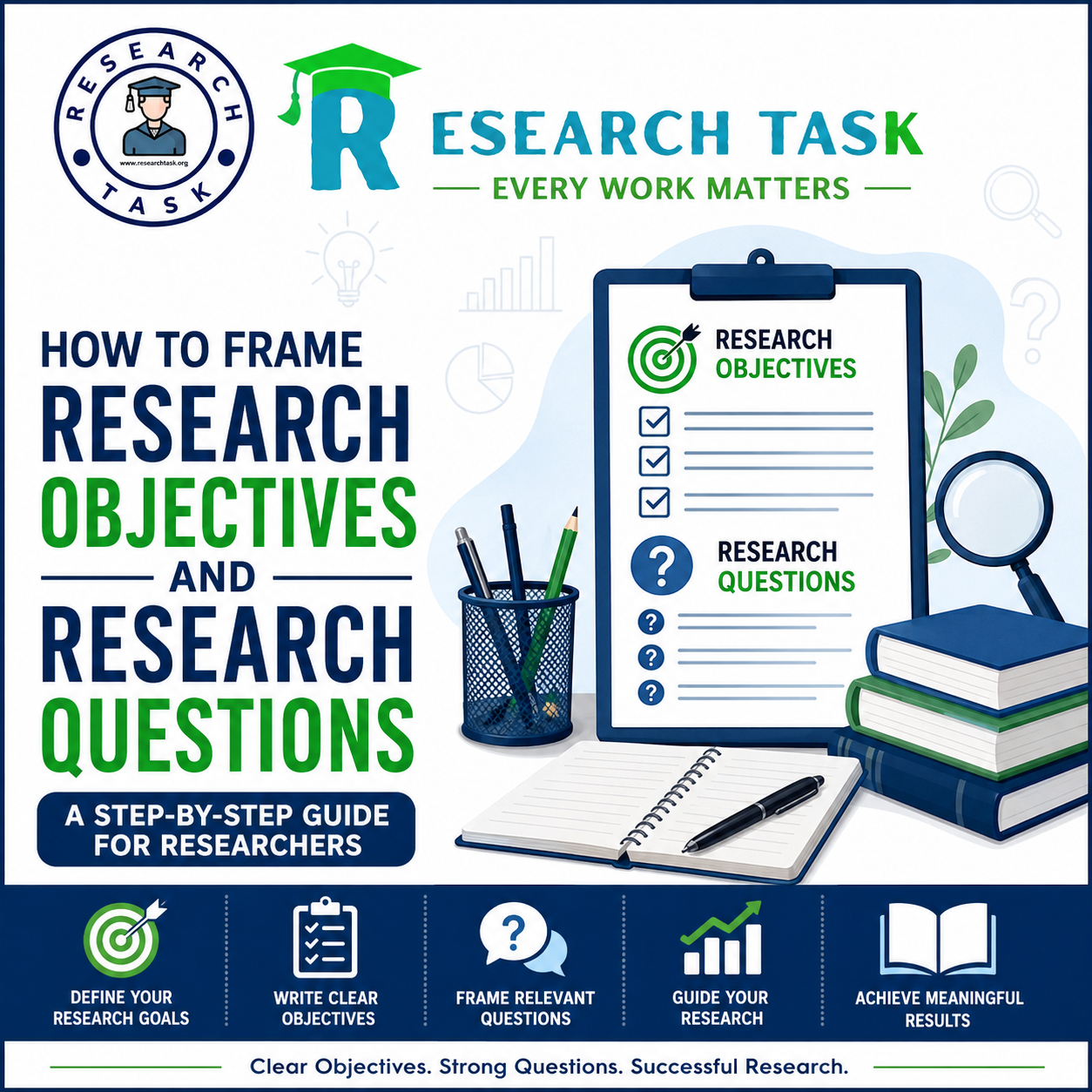
Every successful research project begins with a clear direction. Before collecting data or reviewing literature, researchers need to define what they want to achieve and the questions they intend to answer. This is where research objectives and research questions become essential.
Many students struggle to differentiate between these two concepts, leading to unclear research proposals and weak dissertations. In this guide, you’ll learn how to frame research objectives and research questions effectively, along with practical examples and tips to strengthen your academic work.
What Are Research Objectives?
Research objectives are clear, specific statements that describe the goals of your study. They explain what the researcher aims to accomplish by the end of the research.
Well-written objectives help:
- Define the scope of the study
- Guide the research methodology
- Keep the research focused
- Measure whether the study has achieved its purpose
Example
Research Topic:
Impact of Social Media on College Students’ Academic Performance
Research Objectives:
- To examine the relationship between social media usage and academic performance.
- To identify the average time students spend on social media daily.
- To evaluate whether excessive social media use affects study habits.
- To recommend strategies for balancing social media and academic responsibilities.
Each objective is clear, measurable, and directly linked to the research topic.
What Are Research Questions?
Research questions are specific questions your study seeks to answer. They guide data collection and analysis while helping maintain a clear research focus.
A good research question should be:
- Clear
- Specific
- Researchable
- Relevant
- Feasible
Example
Using the same topic:
- How many hours do college students spend on social media each day?
- Does social media usage influence students’ academic performance?
- Which social media platforms are most frequently used by students?
- What strategies can help reduce distractions caused by social media?
These questions align directly with the research objectives.
Difference Between Research Objectives and Research Questions
| Research Objectives | Research Questions |
| State what the study aims to achieve | Ask what the study intends to investigate |
| Written as statements | Written as questions |
| Focus on goals | Focus on finding answers |
| Guide the research process | Guide data collection and analysis |
Both are closely connected and should complement each other.
Steps to Frame Effective Research Objectives
1. Understand the Research Problem
Begin by identifying the issue your research will address.
Ask yourself:
- What problem exists?
- Why is it important?
- Who is affected?
The clearer your problem statement, the easier it becomes to develop meaningful objectives.
2. Identify Your Main Goal
Determine the overall purpose of your study.
Examples include:
- To evaluate
- To analyze
- To investigate
- To compare
- To examine
- To determine
Use action verbs to make objectives more precise.
3. Break the Goal into Specific Objectives
Instead of one broad objective, divide it into smaller measurable goals.
For example:
General Objective
To study customer satisfaction in online shopping.
Specific Objectives
- To identify factors influencing customer satisfaction.
- To analyze delivery service quality.
- To examine product quality perception.
- To evaluate customer support effectiveness.
4. Make Objectives SMART
Strong research objectives should be:
- Specific
- Measurable
- Achievable
- Relevant
- Time-bound (when appropriate)
Avoid vague statements like:
“To study social media.”
Instead write:
“To examine the impact of daily social media usage on undergraduate students’ GPA during the academic year.”
Steps to Frame Effective Research Questions
Start with Your Objectives
Every objective should naturally lead to one or more research questions.
For example:
Objective
To identify factors affecting employee productivity.
Research Questions
- What factors influence employee productivity?
- Which factor has the greatest impact?
- How can organizations improve productivity?
Keep Questions Focused
Avoid asking multiple things in one question.
Poor Example:
How does technology affect education and employment and communication?
Better Example:
How does technology influence student learning outcomes?
Avoid Yes or No Questions
Instead of asking:
Does training improve performance?
Ask:
How does employee training influence workplace performance?
This encourages deeper analysis.
Ensure Questions Are Researchable
You should be able to answer each question using data, observations, surveys, interviews, or existing literature.
Avoid opinion-based or overly broad questions.
Common Mistakes Researchers Make
Many students unintentionally weaken their research by making these mistakes:
- Writing objectives that are too broad.
- Creating unrelated objectives and questions.
- Using vague language.
- Including too many objectives.
- Asking questions that cannot be measured.
- Ignoring the research problem while framing objectives.
Keeping your objectives and questions aligned with the research problem improves the overall quality of your study.
Practical Example
Research Topic
Effect of Online Learning on Student Performance
Research Objectives
- To evaluate the effectiveness of online learning.
- To examine student engagement during virtual classes.
- To identify challenges faced by online learners.
- To recommend strategies for improving online education.
Research Questions
- How effective is online learning for improving academic performance?
- What factors influence student engagement in online classes?
- What challenges do students experience during online learning?
- Which strategies can improve online learning outcomes?
Notice how every research question corresponds directly to an objective.
Tips for Writing Better Research Objectives and Questions
- Begin with a clearly defined research problem.
- Use action verbs such as analyze, examine, evaluate, and identify.
- Keep objectives concise and measurable.
- Ensure every research question aligns with at least one objective.
- Avoid unnecessary complexity and jargon.
- Review and refine your objectives after completing your literature review.
Why Well-Framed Objectives and Questions Matter
Strong research objectives and questions serve as the foundation of a successful research project. They help define the study’s scope, guide the selection of research methods, improve data collection, and ensure that the final conclusions address the original research problem.
Whether you are preparing a research proposal, writing a dissertation, or publishing an academic paper, investing time in framing clear objectives and meaningful research questions will significantly improve the quality and credibility of your work.
Need Expert Research Guidance?
Developing effective research objectives and questions can be challenging, especially for postgraduate students and PhD scholars. At Research Task, we provide expert assistance with research proposal development, research methodology, thesis writing, statistical analysis, literature reviews, proofreading, and publication support.
If you need professional guidance for your academic research, our experienced team is here to help you build a strong foundation for a successful study.
Frequently Asked Questions (FAQs)
1. What is the difference between research objectives and research questions?
Research objectives describe what the study aims to achieve, while research questions define what the study seeks to answer.
2. How many research objectives should a study have?
Most research projects include three to five specific objectives, depending on the study’s scope.
3. Can one research objective have multiple research questions?
Yes. A single objective may require more than one research question to explore it thoroughly.
4. Should research objectives be measurable?
Yes. Objectives should be specific and measurable to ensure the study remains focused and achievable.
5. Why are research questions important?
Research questions guide the entire research process by shaping data collection, analysis, and interpretation, ensuring the study remains aligned with its goals.