





Writing a dissertation is a long academic journey that involves choosing a research topic, reviewing existing literature, developing a methodology, collecting and analysing data, and presenting your findings. However, completing the research does not mean the work is finished. The conclusion chapter of a dissertation plays an important role in bringing the entire research project together.
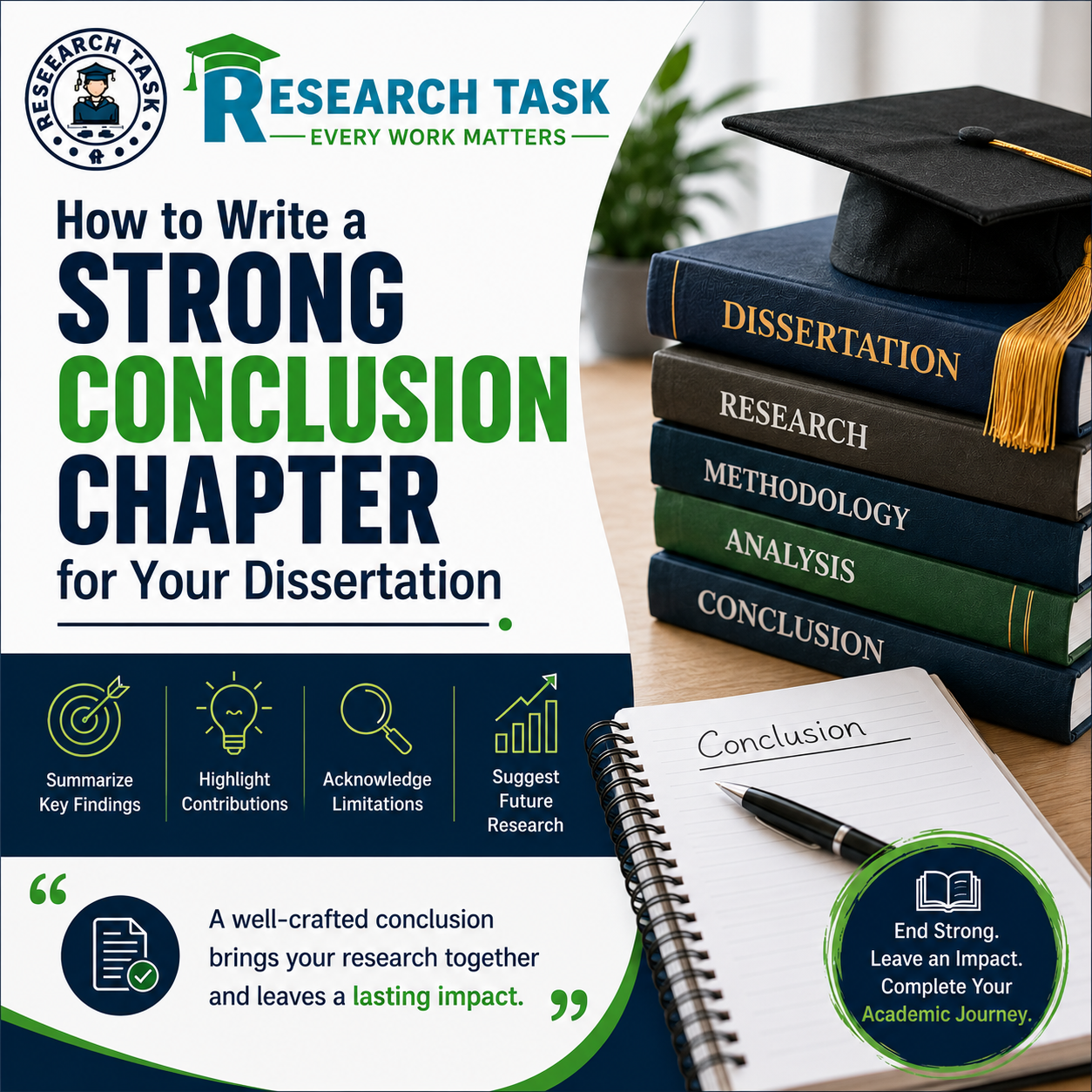
A strong conclusion should not simply repeat everything discussed in previous chapters. Instead, it should demonstrate what the research has established, explain how the findings answer the research questions, highlight the contribution of the study, acknowledge its limitations, and suggest opportunities for future research.
Academic writing guidance from UCL similarly recommends that a conclusion restate the answer or central argument, summarise the discussion, and address implications or suggestions for further research.
If you are wondering how to write a dissertation conclusion, this guide explains the structure, essential elements, common mistakes, and practical tips for creating a strong final chapter.
What Is a Dissertation Conclusion Chapter?
The conclusion chapter is the final major chapter of a dissertation. It brings together the key outcomes of the research and provides a final response to the research problem and questions.
While the results or findings chapter explains what the research discovered, and the discussion chapter interprets those findings in relation to existing knowledge, the conclusion provides the overall answer to the research problem.
A well-written conclusion should help the reader understand:
- What was the research about?
- What were the main findings?
- What do those findings mean?
- How were the research questions answered?
- What contribution does the study make?
- What limitations affected the research?
- What can future researchers investigate?
In many dissertations, the conclusion also includes recommendations and suggestions for future research. The exact structure, however, can vary according to the university, discipline, and dissertation guidelines.
Why Is the Conclusion Important in a Dissertation?
The conclusion is your final opportunity to demonstrate the value of your research.
A dissertation may contain excellent research and detailed analysis, but a weak conclusion can make the overall argument feel incomplete. A strong conclusion leaves the reader with a clear understanding of the research contribution.
It should connect the different parts of the dissertation rather than introduce an entirely new argument.
For example, if your research examined the impact of digital learning on university students, your conclusion should bring together the research objectives, methodology, major findings, implications, and limitations rather than introduce an unrelated topic.
Think of the conclusion as the final synthesis of your research.
What Should Be Included in a Dissertation Conclusion?
Although requirements differ between institutions, a strong conclusion chapter commonly includes several key elements.
1. Briefly Revisit the Research Problem
Begin by reminding the reader what the dissertation set out to investigate.
You do not need to reproduce the entire introduction. Instead, briefly explain the research problem, purpose, or central question.
For example:
This study examined the factors influencing student engagement with online learning platforms in higher education.
This immediately reconnects the reader with the purpose of the research.
2. Restate the Research Objectives or Questions
The conclusion should demonstrate that the research objectives have been addressed.
You can briefly revisit each research question and explain the overall answer provided by your study.
For example:
Research Question 1: What factors influence student engagement with online learning?
Conclusion: The findings indicate that platform usability, instructor interaction, and access to learning resources were among the major factors influencing engagement.
This approach makes it easier for the reader to see how your research fulfilled its original purpose.
3. Summarise the Key Findings
One of the most important parts of a dissertation conclusion is a concise summary of the major findings.
However, avoid simply copying paragraphs from the findings or discussion chapter.
Instead, identify the most important discoveries and present them in a logical sequence.
You might discuss:
- The most significant finding
- Unexpected findings
- Relationships between important variables
- Findings that support previous research
- Findings that challenge previous research
- The overall outcome of the study
The objective is to show the big picture, rather than repeat every statistic, quotation, or observation.
4. Explain the Contribution of the Research
A strong dissertation conclusion should answer an important question:
“So what?”
In other words, why does your research matter?
Your contribution could be:
- Theoretical
- Practical
- Methodological
- Empirical
- Policy-related
For example, your research may provide new evidence about a particular issue, test an existing theory in a new context, identify a previously overlooked relationship, or provide recommendations for professionals.
Make the contribution clear rather than assuming the reader will identify it themselves.
5. Discuss the Implications of Your Findings
Research findings can have implications beyond the dissertation itself.
Depending on your subject, you might discuss implications for:
- Businesses
- Healthcare professionals
- Educators
- Policymakers
- Researchers
- Organisations
- Communities
- Industry professionals
For example, if your research found that flexible working significantly improves employee satisfaction, the conclusion could explain how organisations might use this finding when developing workplace policies.
The implications should be directly connected to your findings rather than based on assumptions.
6. Acknowledge the Limitations of the Study
No research project is completely free from limitations.
A good dissertation conclusion should honestly acknowledge limitations that could have influenced the findings.
Possible limitations include:
- Small sample size
- Limited geographical coverage
- Short research period
- Restricted access to participants
- Reliance on secondary data
- Methodological limitations
- Potential response bias
- Limited availability of relevant data
However, avoid presenting limitations as if they invalidate the entire study.
Instead, explain how they affect the interpretation or generalisability of your findings.
For example:
The relatively small sample size limits the extent to which the findings can be generalised to the wider population. Nevertheless, the findings provide useful insights into the experiences of the participants included in the study.
This presents the limitation honestly while maintaining the value of the research.
7. Provide Recommendations
Depending on your research and university requirements, you may include recommendations based on your findings.
Recommendations should be specific, realistic, and supported by the research.
Instead of writing:
Organisations should improve employee satisfaction.
A stronger recommendation would be:
Organisations could introduce flexible working arrangements and regular employee feedback mechanisms to address the factors associated with lower workplace satisfaction identified in this study.
Good recommendations should tell the reader what could potentially be done and why.
8. Suggest Areas for Future Research
Your research may answer some questions while creating new ones.
The conclusion is an appropriate place to identify areas that future researchers could investigate.
Future research could involve:
- Larger sample sizes
- Different geographical locations
- Different populations
- Longitudinal studies
- Alternative research methodologies
- Comparative studies
- New variables
- Emerging technologies or trends
Avoid generic statements such as “more research is needed.”
Explain what should be researched and why.
For example:
Future research could examine whether the relationship identified in this study remains consistent across different age groups and educational settings.
Recommended Structure of a Dissertation Conclusion
A practical structure could look like this:
1. Introduction to the Conclusion
Briefly remind the reader of the research purpose.
2. Summary of Major Findings
Present the most important findings without repeating the entire results chapter.
3. Answers to Research Questions
Clearly explain how the research questions or objectives were addressed.
4. Research Contribution
Explain what the study adds to existing knowledge.
5. Practical or Theoretical Implications
Discuss why the findings matter.
6. Limitations
Acknowledge important limitations of the research.
7. Recommendations
Provide realistic recommendations based on your findings.
8. Future Research
Identify useful directions for further investigation.
End with a concise statement that reinforces the overall significance of your research.
Not every dissertation will require all these sections separately. Always follow your university’s dissertation guidelines and your supervisor’s instructions.
Conclusion vs Discussion Chapter: What Is the Difference?
Students often confuse the discussion chapter with the conclusion chapter.
Although they are closely connected, they serve different purposes.
| Discussion Chapter | Conclusion Chapter |
| Interprets findings in detail | Brings the research together |
| Compares findings with previous research | Summarises the overall findings |
| Explains relationships and patterns | Answers research questions |
| Provides detailed analysis | Highlights the main contribution |
| May discuss theoretical explanations | Focuses on overall implications |
| Examines findings individually | Presents the bigger picture |
The discussion usually goes deeper into why the findings occurred and how they relate to existing literature.
The conclusion focuses on what the research ultimately tells us.
How Long Should a Dissertation Conclusion Be?
There is no universal word count for a dissertation conclusion.
Its length depends on factors such as:
- Total dissertation word count
- Research methodology
- Subject area
- Number of research questions
- University requirements
- Complexity of the research
As a general writing principle, the conclusion should be long enough to adequately synthesise the research but short enough to remain focused.
Check your university’s dissertation handbook for specific requirements rather than following a fixed percentage.
What Should You Not Include in a Dissertation Conclusion?
One of the biggest mistakes students make is treating the conclusion as another discussion chapter.
Avoid introducing substantial new arguments or evidence that has not been discussed earlier. UCL’s academic writing guidance specifically notes that conclusions generally summarise what has already been presented and are not usually the place for new ideas or new references that require detailed discussion.
Avoid:
Introducing New Findings
Do not suddenly introduce research results that were not presented earlier.
Adding Extensive Literature
The conclusion is not normally the place for a new literature review.
Repeating Entire Paragraphs
Summarise the main points instead of copying sections from earlier chapters.
Making Unsupported Claims
Every major conclusion should be supported by your research.
Overstating the Findings
Avoid claiming that your research proves something beyond what your methodology and evidence can support.
Introducing Unrelated Recommendations
Recommendations should emerge logically from your research findings.
Common Mistakes to Avoid
Mistake 1: Simply Repeating the Introduction
The conclusion should reconnect with the introduction, but it should not simply reproduce it.
Mistake 2: Introducing New Information
New arguments can confuse the reader and weaken the structure of your dissertation.
Mistake 3: Being Too General
Statements such as “this research is important” are not enough. Explain why it is important.
Mistake 4: Ignoring Research Questions
Your conclusion should clearly demonstrate whether and how the research questions were answered.
Mistake 5: Overloading the Conclusion With Statistics
The detailed statistical analysis belongs in the relevant findings and discussion chapters. Use only the information necessary to communicate the overall conclusion.
Mistake 6: Making Recommendations Without Evidence
Recommendations should be based on your research rather than personal opinions.
Mistake 7: Ending Abruptly
Your final paragraph should provide a clear sense of completion and reinforce the significance of the research.
How to Make Your Dissertation Conclusion Stronger
Start With Your Research Questions
Before writing the conclusion, list all your research questions or objectives. Under each one, write the main answer provided by your study.
This gives you a clear foundation for the chapter.
Review Your Main Findings
Go through your findings and discussion chapters and identify the three to five most important insights.
Your conclusion should focus on these rather than every detail.
Connect Findings to Objectives
Ask yourself:
Did my research achieve what it originally set out to achieve?
If not, explain why.
Focus on Synthesis
Do not simply summarise chapter by chapter.
Instead, show how the findings work together to answer the central research problem.
Keep the Language Precise
Academic conclusions benefit from clear and cautious language.
Useful phrases include:
- “The findings indicate that…”
- “This study demonstrates…”
- “The research suggests that…”
- “Taken together, the findings suggest…”
- “The study contributes to…”
- “A key implication of these findings is…”
- “One limitation of the study is…”
- “Future research could examine…”
End With Significance
Your final paragraph should leave the reader with a clear understanding of why the research matters.
A Simple Dissertation Conclusion Template
You can use the following structure when planning your chapter:
Opening:
“This dissertation examined [research topic] with the aim of [research aim].”
Findings:
“The findings indicate that [key finding 1], while [key finding 2].”
Research Questions:
“Taken together, these findings address the research questions by demonstrating that [overall answer].”
Contribution:
“This study contributes to existing research by [specific contribution].”
Implications:
“The findings have implications for [industry/practice/theory/policy] because [reason].”
Limitations:
“However, the study has several limitations, particularly [limitation].”
Future Research:
“Future research could address these limitations by [specific suggestion].”
Closing:
“Overall, the research demonstrates that [central conclusion], highlighting the importance of [broader significance].”
This is a framework rather than a formula. Your final conclusion should reflect the specific research questions, methodology, findings, and contribution of your dissertation.
Final Checklist Before Submitting Your Dissertation
Before submitting your dissertation, review the conclusion and ask:
- Does the conclusion clearly answer the research problem?
- Have all research questions or objectives been addressed?
- Have I summarised the most important findings?
- Have I explained the contribution of my research?
- Are the implications supported by my findings?
- Have I acknowledged important limitations?
- Are my recommendations realistic?
- Have I identified meaningful areas for future research?
- Have I avoided introducing major new arguments?
- Does the conclusion connect with the introduction?
- Is the academic language clear and appropriately cautious?
- Does the final paragraph provide a strong sense of closure?
Final Thoughts
A strong dissertation conclusion does more than bring the document to an end. It demonstrates that the research has a clear purpose, that the research questions have been addressed, and that the findings make a meaningful contribution.
The most effective approach is to synthesise rather than repeat. Bring together your key findings, explain their significance, acknowledge the limitations of the study, and show what future researchers or practitioners can learn from your work.
Remember that your conclusion should answer the central question behind every research project:
What did this research discover, why does it matter, and what should happen next?
By answering these questions clearly and logically, you can create a conclusion chapter that gives your dissertation a strong and academically convincing ending.